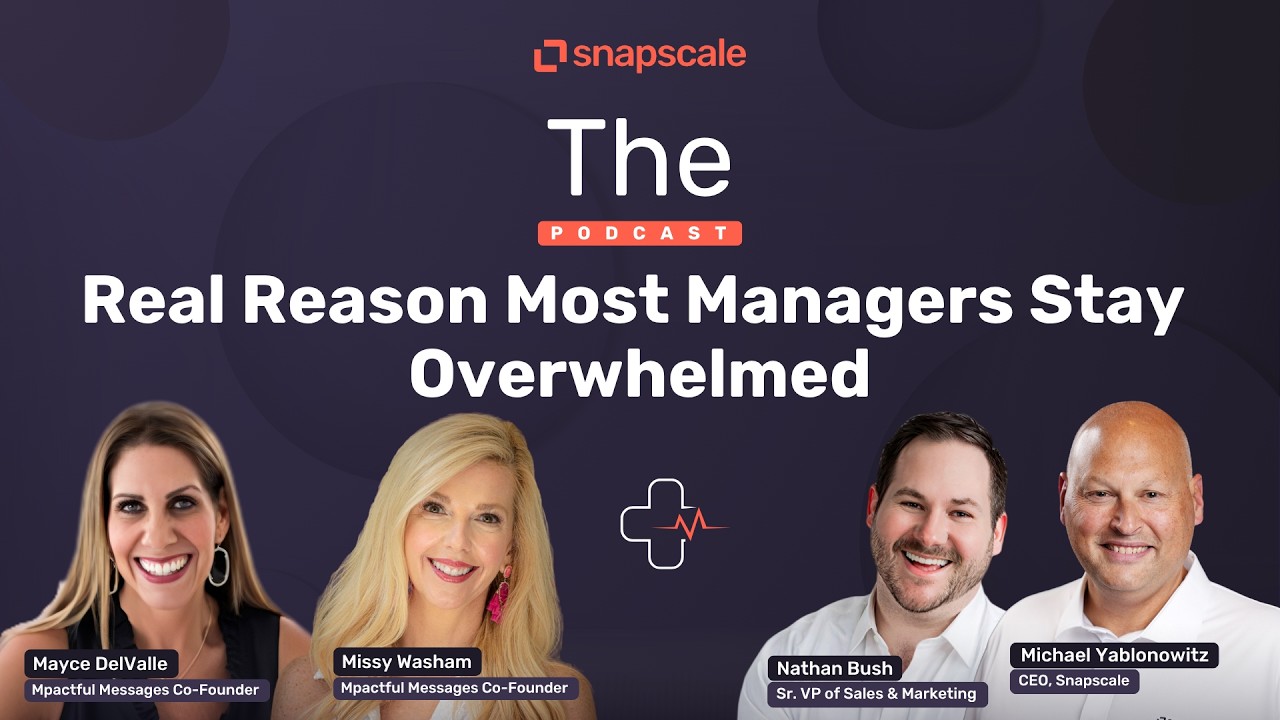
You're Not Overworked. You're Carrying Your Team's Work

schedule ~52 min groups Leadership & Management public Remote · Offshore Teams

Leadership coaches Mayce DelValle and Missy Washam have trained managers across the U.S. and internationally, and they say most overwhelmed leaders aren't doing too much work. They're doing their team's work. Hear why practice owners default to either micromanaging or going hands-off, and the systems that get them out of the middle.

MD
Mayce DelValle
·  Co-Founder, Impactful Messages
·  Leadership coach, DISC practitioner
MW
Missy Washam
·  Co-Founder, Impactful Messages
·  Leadership coach, former educator

Mayce DelValle & Missy Washam — Leaders Burn Out Carrying Their Team's Work

Episode Playbook

How to Lead a Remote Team Without Micromanaging It

The Diagnosis
You're not overworked, you're over-involved
Leaders drown because they're afraid to empower people, and they confuse wanting to be needed with being effective. The more they put their fingers in the pie to make sure it turns out their way, on their timeline, the more exhausted and frustrated they get. Meanwhile the work often gets done faster and better without them in the middle of it.
Step One
The checkup from the neck up
Self-leadership comes first. Two questions: what kind of leader am I, and what kind of leader do I want to be? If you can't manage your own time, your own emotions, the way you communicate, and your priorities, you're not going to manage those things across a team. Lead yourself well and the team follows the example.
Step Two
Connection is the hub, not a spoke
Most leaders connect once, at onboarding, then never again. Mayce and Missy connect with each other daily and with their remote team weekly. Their meeting formula: every meeting, including one-on-ones, needs motivation, information, and a celebration. A rotating "question of the week" does the connection work without adding a meeting.
Step Three
Clarity is measured by what they heard
Accountability feels harsh when people don't know the standard. So check the landing, not the sending: "What did you hear me say?" and "What questions do you have?" rather than "Do you have any questions?" Across cultures this matters more, not less. Team members in the Philippines, India, or Mexico may agree out of respect without understanding. Use translated SOPs, screen recordings, and one baby-step task before handing over the whole workflow.
Step Four
Systemize it or it won't survive the week
Anything worth doing is worth systemizing. Put the connection question on the calendar. One of their clients in the oil business has emailed a weekly connection question to a team with no cell reception for sixty-something straight weeks running. One guest's husband, who runs a nonprofit, has "write handwritten notes" on his calendar every Friday, precisely because almost nobody writes handwritten notes anymore.
The Payoff
Commitment instead of compliance
Compliance can be required. Commitment has to be inspired, and that's what connection buys you. Connected teams bring solutions instead of problems, stay late when it counts, and rise to the level of expectation you set. Disconnected ones check the boxes in their job description and stop there.
The micromanaging leader
Operates from fear of mistakes and losing control
"If it's going to be done, it's going to be done my way"
Connects at onboarding, then never again
Answers every question, so the team stops bringing solutions
Becomes the bottleneck, then blames the bottleneck
Gets exactly the job description and nothing more
The empowering leader
Starts with self-awareness, the checkup from the neck up
Cares that results happen, not how they happen
Connects on a rhythm: weekly, calendared, systemized
Sends problems back: "What idea do you have to fix it?"
Confirms understanding instead of assuming it
Earns commitment, so the team goes past the job description
5 min
Daily reflection: what went well, what didn't, one fix
3
Parts every meeting needs: motivate, inform, celebrate
52
Weeks of connection questions, round-robin them
1
Change at a time, until it becomes a habit

"Leaders have to slow down to go fast."

— Missy Washam, Co-Founder · Impactful Messages

"When people are trusted, when they're known, when they have clear expectations, accountability can actually feel empowering."

— Mayce DelValle, Co-Founder · Impactful Messages

Key Takeaways

What Every Practice Owner Can Learn From This Episode

01
Fix the Leader Before the Org Chart
The "checkup from the neck up" comes first. If you can't manage your own time, emotions, communication, and priorities, no reporting structure will fix it. Ask what kind of leader you are, and answer honestly.
02
Micromanaging Isn't a Habit, It's Fear
Fear of mistakes, of losing control, of someone doing it better than you. Naming the fear is what makes it fixable, and it explains why leaders swing between micromanaging and going completely hands-off with nothing in between.
03
You Manage Process, You Lead People
Management is systems and tasks, leadership is people. Being in management doesn't make you a leader, and "managing people" isn't a thing. Both are required, but only one of them earns you commitment.
04
Give Every Meeting Three Parts
Motivation, information, and celebration, in group meetings and one-on-ones. And if the information could have been an email, it should have been. People who feel noticed do more, whether they're in the room or nine time zones away.
05
Ask "What Questions Do You Have?"
Not "do you have any questions?" The assumptive version gives people permission to admit they didn't follow. Critical with offshore teams, where saying yes can be respect rather than understanding.
06
If Your Team Is Dependent, You Built That
Keep handing out answers and you've trained your team to come back for more. Send the problem back, "what idea do you have to fix this?", and the bottleneck starts to dissolve. The buck stops with the leader either way.

Straight From the Conversation

Moments Worth Revisiting

On Why Leaders Burn Out

"Many leaders don't burn out because they're overworked. They burn out because they're carrying the work of their team."

Nathan Bush, Host
On Micromanaging

"Micromanaging makes you feel like, why did you hire me in the first place? If you've given me this task, then trust me to do it."

Missy Washam
On What Holds It Together

"If you think of leadership as a tire and connection is in the center, then you have all these spokes of the tire. But connection is the hub."

Mayce DelValle
On Leading Remote Teams

"That connection and that communication and that building of trust, it's not about proximity. It's about intentionality."

Missy Washam
On Management vs. Leadership

"Management is about processes and tasks, leadership is about people. Just because you're in management doesn't make you a leader. If you don't put the people first, you're not a leader. You are just a manager."

Missy Washam
On Clarity

"Just because you said it doesn't make it so. It doesn't make it clear. It's clear to you. You said it. But that's the least important part. Is it clear to your team?"

Mayce DelValle

Free Resource

Get the Remote Team Leadership Toolkit From This Episode

We've packaged the frameworks Mayce and Missy walked through, the meeting structure, the connection questions, and the clarity checks, into templates you can use at your next team huddle.

  • Connection Question Bank (52 weeks, ready to round-robin)
  • 3-Part Meeting Agenda Template
  • 5-Minute Daily Reflection Sheet
  • Cross-Cultural Clarity Checklist for offshore staff
  • New episode alerts + 1 key takeaway per show